
Finding Adrian Residents by Record Type
An Adrian residents directory search works best when the search begins with a role, not just a name. A parcel page can identify a recorded owner or taxpayer. A deed index identifies parties to a transaction. A city directory may identify a head of household at a given address. A newspaper item may document an event, not residence. Those labels matter because no verified public file lists every person who lives in Adrian.
Use a current address for a property trail, a full name and date range for court or historic work, and an old street number for a directory or map search. Keep the exact spelling, the municipality, and the year beside each result. A Lenawee County directory can include Adrian and nearby townships, so a mailing city alone is not enough to establish city jurisdiction.
- Search the county property route by address, parcel number, or owner name to identify the parcel and its stated record date.
- Check the county GIS map to compare the parcel shape, street, and jurisdiction before treating an address as an Adrian city parcel.
- Use the Register of Deeds index for the recorded owner trail, then inspect the instrument image and legal description where access allows.
- For a former household, compare a directory year with newspaper, census, or archival material rather than relying on one listing.
- Ask the custodian for an existing record when the online result is incomplete, giving a name, address, date range, and record type.
Note: A deed, parcel card, and directory entry each describe a different relationship to an Adrian address and should not be treated as interchangeable proof.
Adrian Offices Behind Resident Records
Adrian is the Lenawee County seat, so the main property, deed, vital, election, and court routes are held by county offices in or near the city. Each office answers a narrower question. The Register of Deeds preserves recorded land instruments. Equalization and municipal assessors handle assessment questions. The County Clerk handles vital records and elections. The library and museum hold the historic tools that do not belong in a current government portal.
Lenawee County Register of Deeds
301 N Main St
Adrian, MI 49221
517-264-4538
Lenawee Equalization
301 N Main St, first floor
Adrian, MI 49221
517-264-4522
Lenawee County Clerk
113 W Front St, Annex
Adrian, MI 49221
517-264-4606
The detailed address chain needs its own street-level treatment. Here, the useful rule is simpler: record the agency, series, and date before drawing a conclusion from a person’s appearance in a public record.
Adrian Parcels Through BS&A and GIS
Lenawee County routes public property research to BS&A Online, community UID 431. It accepts a property address, parcel number, or owner name in Last, First form. Its public surface separates assessment, tax, building, utility, special-assessment, and other categories. A name on a parcel may be an owner, taxpayer, trust, estate, or mailing contact. It is not automatically a current household list.
The county GIS page supplies the map side of that work. Search results can be compared to roads, parcel boundaries, political features, aerial imagery, and other layers. The county cautions that transfers can lag in GIS and that map data is not a certified survey. Capture the TaxID, situs address, and legal jurisdiction before taking the next step in a deed or directory search.
| BS&A search field | Format or use | Record connection |
|---|---|---|
| Address | Standardized street and number | Finds a situs or street-based record |
| Name | Last, First | Finds an owner or named account role |
| Parcel Number | Exact TaxID characters | Links assessment work to mapping and deeds |
| Building Record Number | Portal-specific record number | May locate a public building-file reference |
| Advanced Address Search | Street address or number range | Useful for a narrow street segment |
The BS&A public search is shown in the captured Adrian residents directory reference image below.
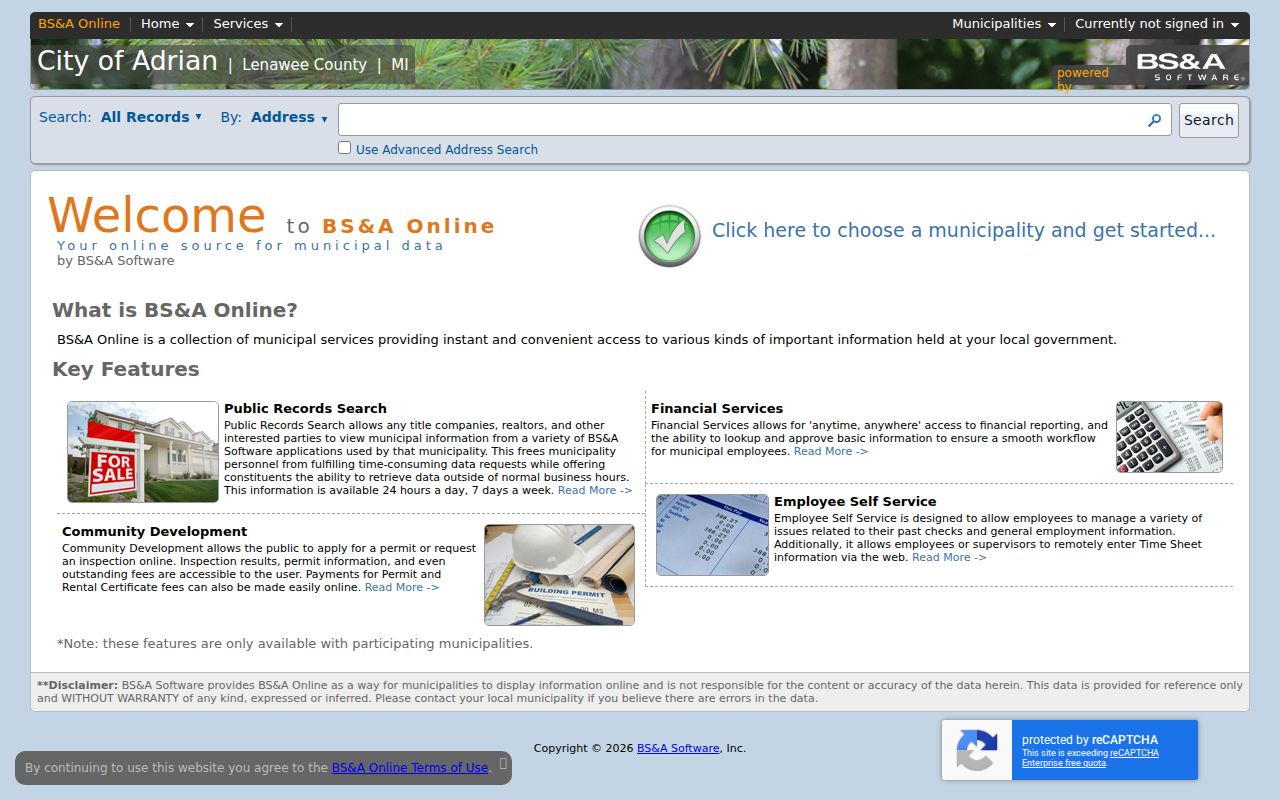
The screen is a starting surface, not proof of occupancy. Pair a displayed field with its label, tax year, and the original custodian before relying on it.
Lenawee Deed Names in Adrian Records
The official Lenawee land-record search is a party and instrument index, not a residents directory by itself. It supports real-property searching by recorded date, party names, grantor, grantee, document type, liber, page, legal form, and an OCR phrase. Start broadly with a surname, then narrow by date only after the possible matches are understood. OCR can help find a phrase in an image, but handwriting and older type should be checked against the actual record.
A useful chain is parcel or TaxID, current grantee, latest deed, then the previous grantor as the next grantee search. Save the instrument number, recording date, legal description, and the roles named. The portal’s beginning coverage year was not stated in the inspected sources. Older records may require the research vault, books, microfilm, library, or archive route.
- Grantor
- The party transferring an interest in a recorded instrument.
- Grantee
- The party receiving that interest, not necessarily a resident of the parcel.
- Liber and page
- A book and page reference used to locate an older recorded item.
- Parcel
- A mapped unit of land identified for assessment and geographic reference.
Current Adrian Resident Record Routes
Current sources are strongest when they answer a defined question. Property systems help locate a parcel and a recorded owner. The voter route concerns registration information subject to statutory limits. Court, corrections, registry, license, and business systems each cover a different population or role. An empty result in one does not clear a person from every system or establish that someone has never lived in Adrian.
| Current source | What it may confirm | Custodian | Access route |
|---|---|---|---|
| Property and assessment search | Parcel, owner/taxpayer role, situs and mailing fields | Lenawee County and local assessor | BS&A public route |
| Recorded land index | Parties, document type, date, legal description | Register of Deeds | Official index, office, vault |
| Voter registration route | Registration information released under election law | Michigan and county elections | MVIC or scoped QVF request |
| MiCOURT case search | Public case-index information and party roles | Michigan courts | Online index, clerk, public terminal |
| Professional license search | License status and discipline where published | Michigan LARA | Free state search |
Official records identify the custodian, record type, and access date. That makes them easier to check than a compiled people-search result.
| Official Adrian record route | Commercial people-finder category |
|---|---|
| Shows the responsible county, state, court, library, or archive source and a defined record role. | May combine material with unclear source dates, user-supplied details, or stale address associations. |
| Lets the researcher inspect an original index, image, or request process and correct a mistake through its custodian. | Can be useful as a lead but does not replace the underlying record or its privacy limits. |
A name that needs careful comparison across those systems is better handled as a resident lookup, where address, date, and record role can be checked together.
Michigan Voter Records for Adrian
Michigan’s Voter Information Center is the official public lookup route. Broader voter data can be requested through the Bureau of Elections QVF FOIA process, with a defined geography or election-history scope. A request should be narrow and tied to a civic or historical purpose. The field-level inspection of MVIC was a research gap because automated capture was blocked, so do not assume a particular search field or result layout without checking the live service.
Public availability has limits. Day and month of birth, driver or state ID numbers, phone numbers, email, signatures, initial registering office information, and refusal-to-register data are protected. A registration record is also not a household census. It may be one confirmation point beside an address, directory, or other dated record.
Michigan Voter Information Center appears in the captured Adrian residents directory reference image.
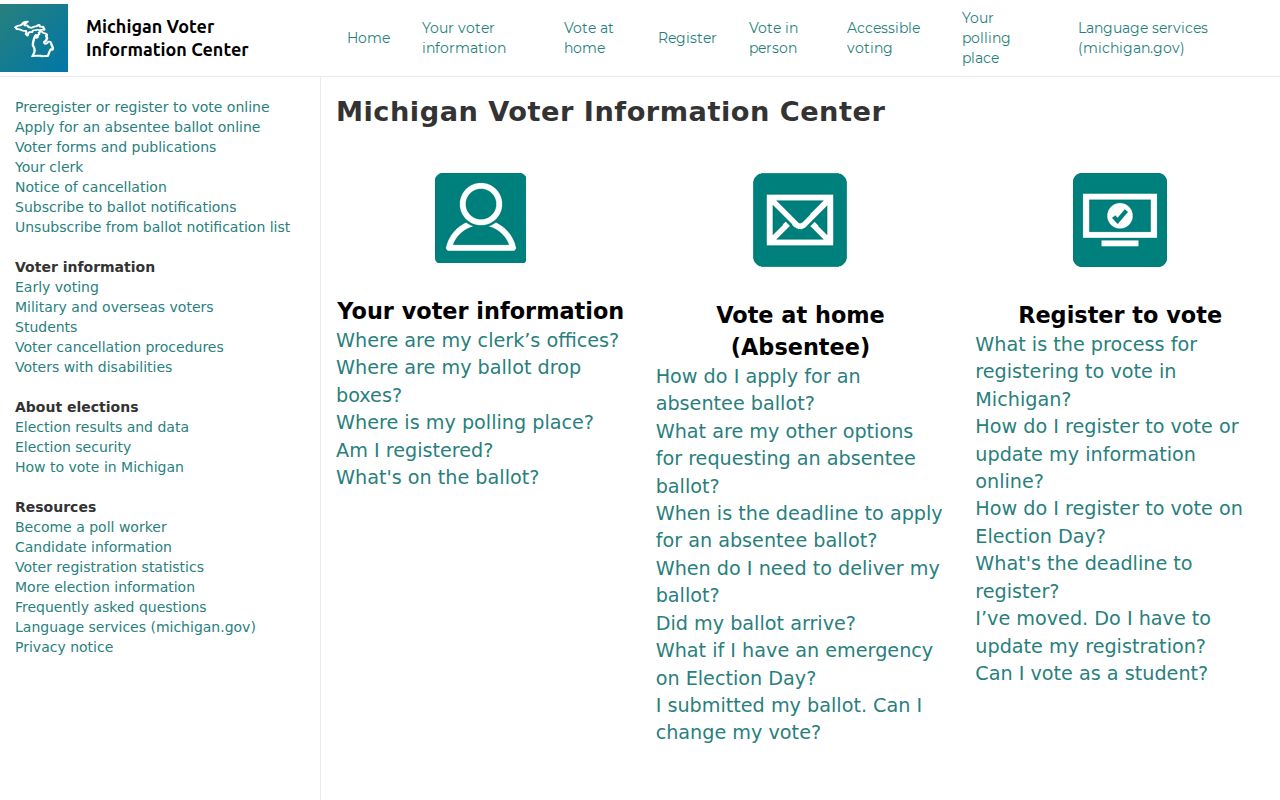
Use the official route and retain only the minimum information needed for a lawful research question.
Adrian Court and Public Safety Indexes
MiCOURT is a discovery index for public Michigan case information. Lenawee’s 39th Circuit Court and 2A District Court use the statewide search alongside local clerk and terminal access. A docket is a chronological case record, not a personal profile. Read the court, case category, party role, date, and disposition before assuming a name match belongs to the right Adrian person.
Public-safety systems are separate. The county jail has no public online roster identified in the research. OTIS covers current state prisoners, parolees, probationers, and people discharged within three years, not everyone who has passed through a county jail. ICHAT, the public registry, court files, and federal PACER have their own access rules and coverage boundaries.
Michigan OTIS is captured as an Adrian residents directory reference.
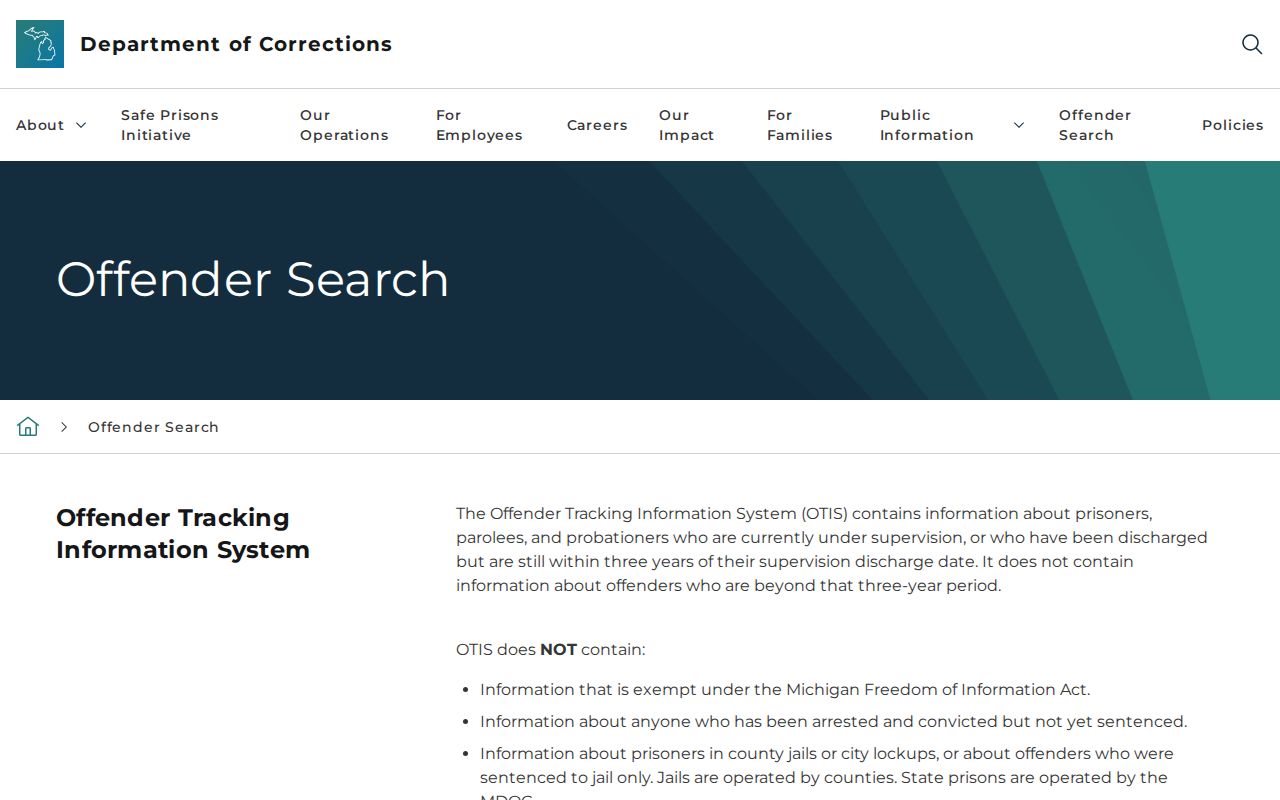
The result screen must be read with OTIS’s population and time-window limits in mind.
Michigan’s public registry is also represented in the reference capture.
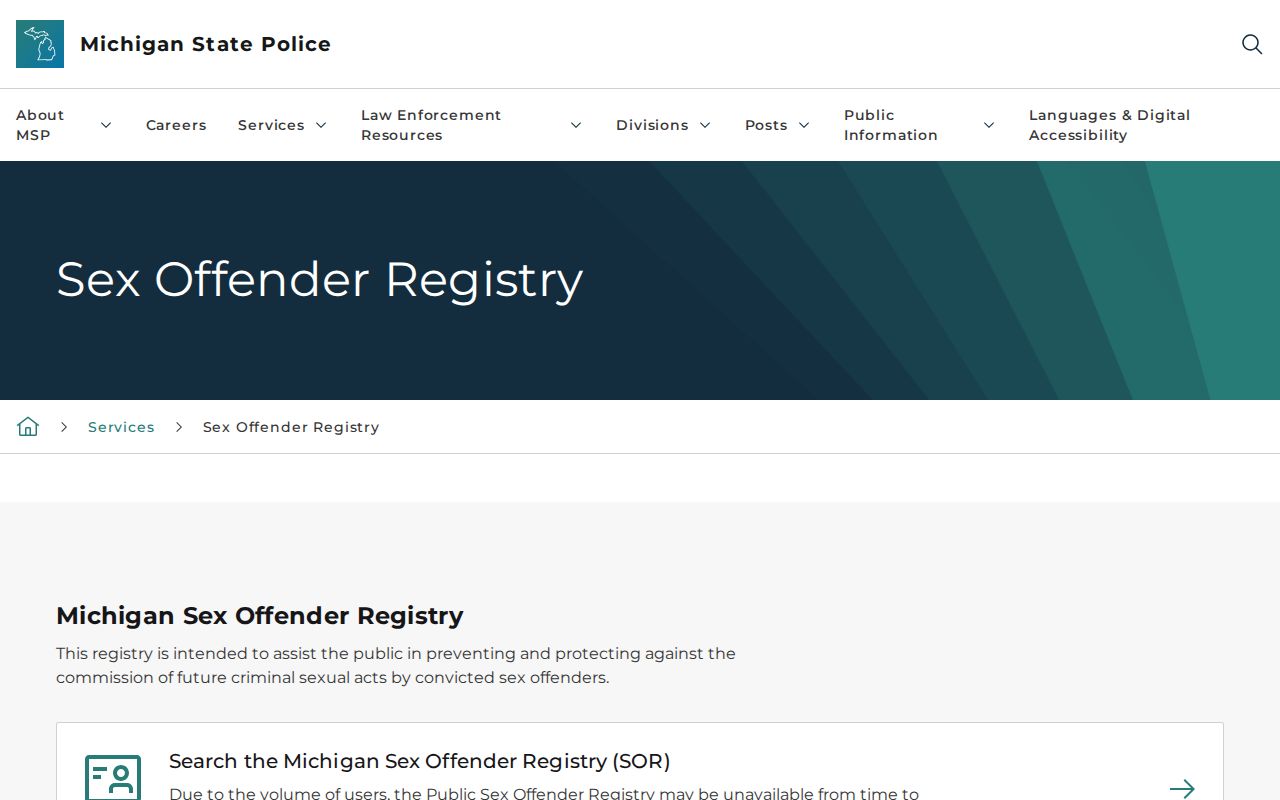
The registry has a lawful safety purpose and does not replace court, jail, or statewide criminal-history records.
Note: A missing name in one public-safety system is not evidence of a complete record history or a reason to make an assertion about a person.
Adrian Heritage Room Directory Evidence
The Adrian District Library Heritage Room is the first local stop for historic directory work, newspapers, census microfilm, local indexes, vital-reference material, and government proceedings. Its published hours are Monday through Thursday 9:30 to 8:00, Friday 9:30 to 5:30, and Saturday 9:30 to 3:00. Staff asks email requesters to give a focused person, event, location, and date rather than an open-ended family-tree request.
The Daily Telegram Collection is described as running from 1893 to the present, while local archive descriptions point to Adrian papers back to 1849. Newspapers can provide a lead about a sale, event, obituary, notice, or business. Verify that lead with the page image and a record that answers the next question. The library’s microfilm equipment can save images to USB or print, subject to local use rules.
The Lenawee Circuit Court public-record page is shown in this capture because it illustrates the county-seat route that often follows a library discovery.
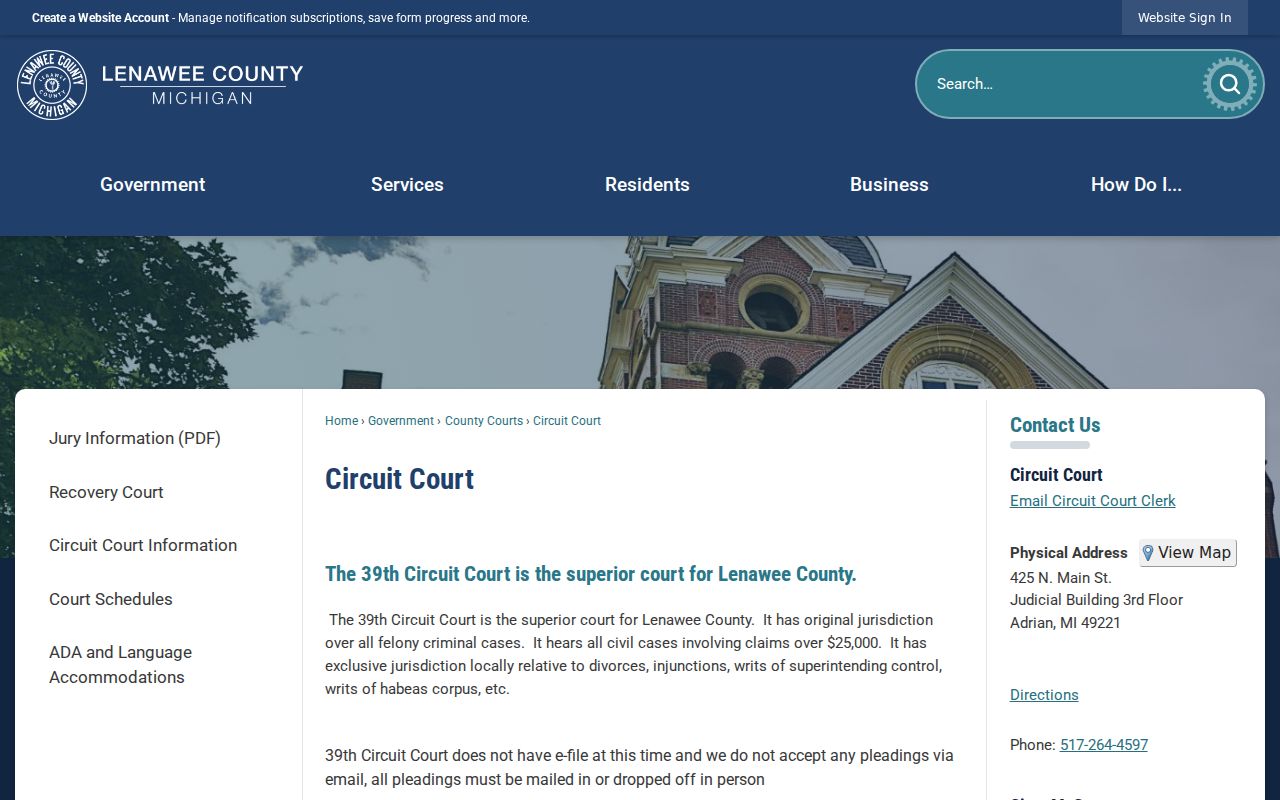
When a historic finding points toward a court or probate matter, use the clerk’s process rather than assuming a full file is online.
Adrian Residents and Unclaimed Property
Michigan’s unclaimed-property database is a name or business-name search that can provide an heir or family-history lead. It is not a directory of current addresses. A claimant must meet the state’s documentation and identity rules, and an apparent name match needs supporting evidence from the official claim process.
Michigan Treasury noted in January 2026 that the official database updates multiple times each year. That makes a repeat search reasonable when a prior search is old, but it does not make an unsolicited caller an authorized helper. Start at the known state portal, not at a link or number sent in a message.
The Treasury’s 2026 search notice is captured below.
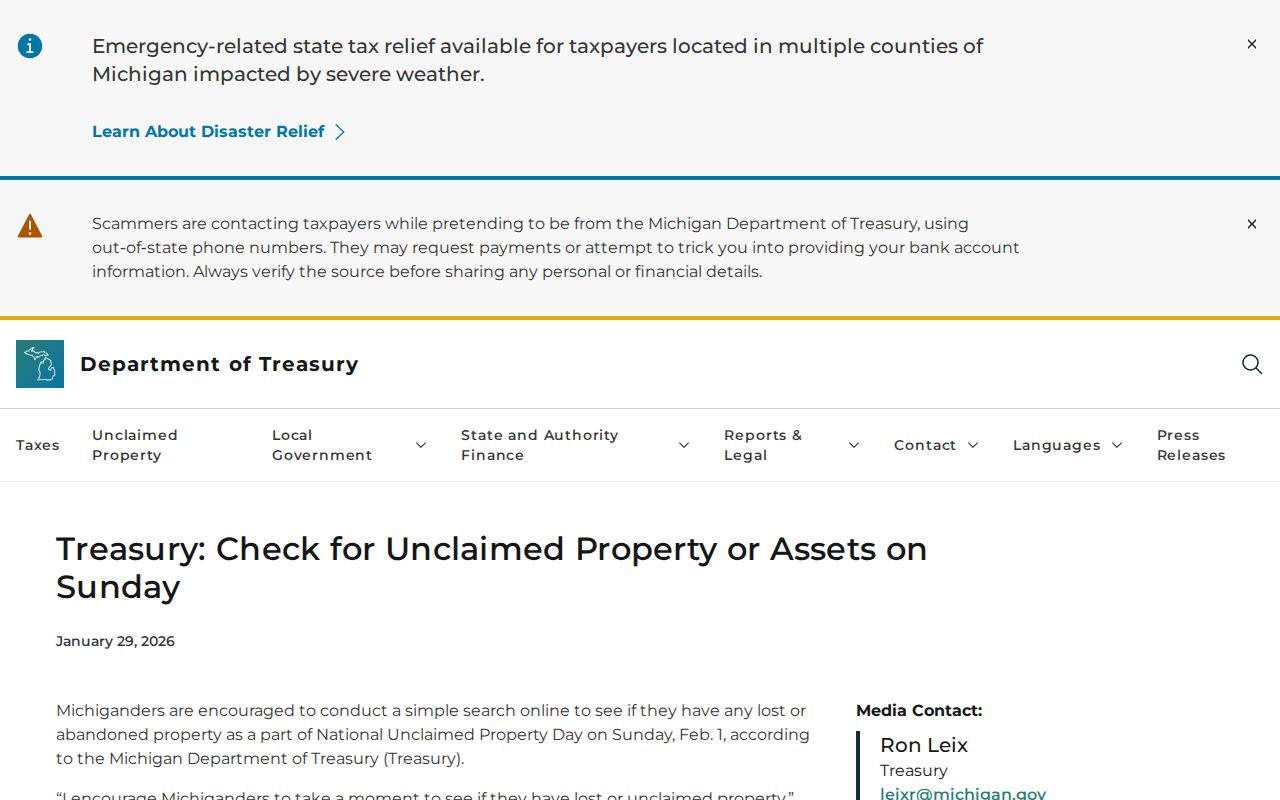
Use a possible result as a prompt to collect relationship and estate documentation through the official claim channel.
Historical Adrian Residents Directory Runs
Observed Adrian directory pointers begin with 1859 and include 1870, 1876, the 1897 Lenawee County Directory, pre-World War I volumes, 1921, late-1920s titles, selected 1930s and 1940s volumes, and material through 1960. Those are observed holdings or collection pointers, not proof of an uninterrupted annual run. Note the title, publisher, page, and whether the entry comes from a surname or street section.
Polk-style books may list a name, occupation, household details, and ownership notation. Bresser or criss-cross books reverse the approach by organizing street and house number. A criss-cross directory can be a powerful bridge from an address to the head of household in a particular year. The complete collection and reading method sit with the Adrian city directory resources.
- Listed resident
- A person shown in a directory for that edition and section.
- Recorded owner
- A party named in property or deed evidence.
- Newspaper subject
- A person mentioned in a dated news item or notice.
- Registrant
- A person in a voter, license, or similar administrative record.
These roles may overlap, but the label prevents a historical lead from being overstated as a current fact.
Adrian’s 1916 Address-Change Clue
The August 1916 Sanborn book includes old and new Adrian street numbers. That local feature can explain why a household seems to vanish from one directory year and appear at a different number in the next. Compare the 1915 to 1917 directory sequence, the Sanborn notation, the parcel’s legal description, and address cards before calling it a move.
The Lenawee Historical Museum’s house-research materials point to street and address cards, survey cards, picture cards, House Abstracts in Range #1, city and county directories, maps, and tax journals. A local guide also describes a 2024 volunteer photography effort for City Tax Records. Those are collection leads, so check current archive access and inspect the source itself before quoting any name or date.
Adrian Records Requests and Privacy
Michigan Freedom of Information Act requests under MCL 15.231 et seq. must be written and sufficiently describe existing records. The ordinary response period is five business days, with a written extension of up to ten business days. Search, review, separation, copying, and mailing can create lawful fees. Courts and court clerks acting in that capacity follow their own access rules, so a court-file request is not simply an ordinary FOIA request.
Birth records under 100 years, adoption material, juvenile and mental-health matters, victim information, protected voter fields, and Address Confidentiality Program information require special treatment. Michigan ACP supplies a substitute address and mail forwarding for eligible survivors. Public access to one record never justifies using another source to expose a protected location.
PACER’s federal court access page is included as an Adrian residents directory reference for the distinct federal-court route.
Federal case access has its own account and fee rules, so it should never be treated as a county court result.