
Adrian Address Record Sources by Era
The most useful source changes with the era. An Adrian property record can lead into a current parcel and a recorded transfer. Earlier households are often better found in a year-specific directory, newspaper, census schedule, museum card, or probate file. The years below identify observed Adrian access points. They do not create a seamless run, and the Register of Deeds pages inspected did not state the first year available online. For any gap, use the custodian’s offline holdings before deciding a trail has ended.
| Adrian source | Years it covers | Where held | What it can show |
|---|---|---|---|
| Recorded deed index | Online start year not stated | Register of Deeds portal, vault, and deed books | Grantor, grantee, date, instrument, legal description |
| Assessment and parcel material | Current public route; retention not stated | BS&A and county GIS | TaxID, situs, owner or account, map placement |
| Adrian directories | Observed pointers from 1859 through 1960 | Heritage Room, museum, library collections | Historic street or household listing where a volume provides one |
| Federal census microfilm | 1830–1930 at the Heritage Room | Adrian District Library | Household sequence and period details |
| Local newspapers | Archive descriptions reach back to 1849; Daily Telegram 1893–present | Adrian District Library | Dated notices, obituaries, sales, and public events |
| Probate genealogy material | Back to 1827 | Lenawee Probate access route | Estate, heir, administrator, and property-transfer leads |
For recent previous residents, begin with parcel and deed sources. For a nineteenth- or early twentieth-century house, begin with the directory year nearest the question, then use newspaper, map, census, and probate clues to test the result. The observed directories include gaps, and a county directory can include households outside the City of Adrian. Record the municipality or township every time.
Adrian Address Records Before Search
Freeze the address as it was printed before normalizing it for a search. Preserve the house number, directional word, suffix, unit, rural route, post-office box, township name, and source date. Then try the standardized form in GIS, assessment, and deed work. A legal description may omit the street number altogether. In that case, the TaxID and legal description are the bridge, not a guess based on a similar street name.
Adrian has a local trap worth checking first. The August 1916 Sanborn book includes old and new street numbers. A household listed under one number before 1916 and another number afterward may still be at the same building. Compare the street section, the Sanborn note, a parcel or legal description, and a dated newspaper item before treating the change as a move. The address needs to match in time as well as in spelling.
Adrian Architecture’s historic collection links identify the relevant Sanborn, early-directory, and county-directory leads. The collection list does not prove that every year survives. It is a route to a volume, map, or archive record that still needs page-level inspection.
Tracing Adrian Previous Residents Through Deeds
A Lenawee deed chain is the ownership spine for prior-resident research. Use the county property route to locate the current parcel or TaxID, then confirm its shape and jurisdiction in Lenawee Mapping/GIS. In the Register of Deeds index, look for the present owner as grantee and open the latest matching instrument. Copy the grantor, grantee, recording date, document number, liber and page, legal description, and any reference to an earlier instrument.
- Write down the Adrian situs address, parcel or TaxID, and legal description from the property and map records.
- Search the present owner as a grantee in the official deed index and match the address or legal description to the parcel.
- Read the deed image when available. Record the seller, instrument type, recording date, document number, liber, page, and prior reference.
- Search that seller as a grantee to find the preceding purchase. Repeat the legal-description check at every transition.
- When the online result stops, ask the Register of Deeds about the research vault, deed books, or microfilm and use library or archive holdings for related historic evidence.
- Grantor
- The party transferring an interest in a recorded instrument.
- Grantee
- The party receiving that interest. A grantee search can reveal a purchase, not a complete residence history.
- Chain of title
- The sequence of recorded transfers connected by the same parcel or legal description.
- Legal description
- The land description in the recorded instrument. It is more stable than a street number when an address changes.
The Lenawee Register of Deeds advanced search is the official interface shown here for beginning a document or party search.
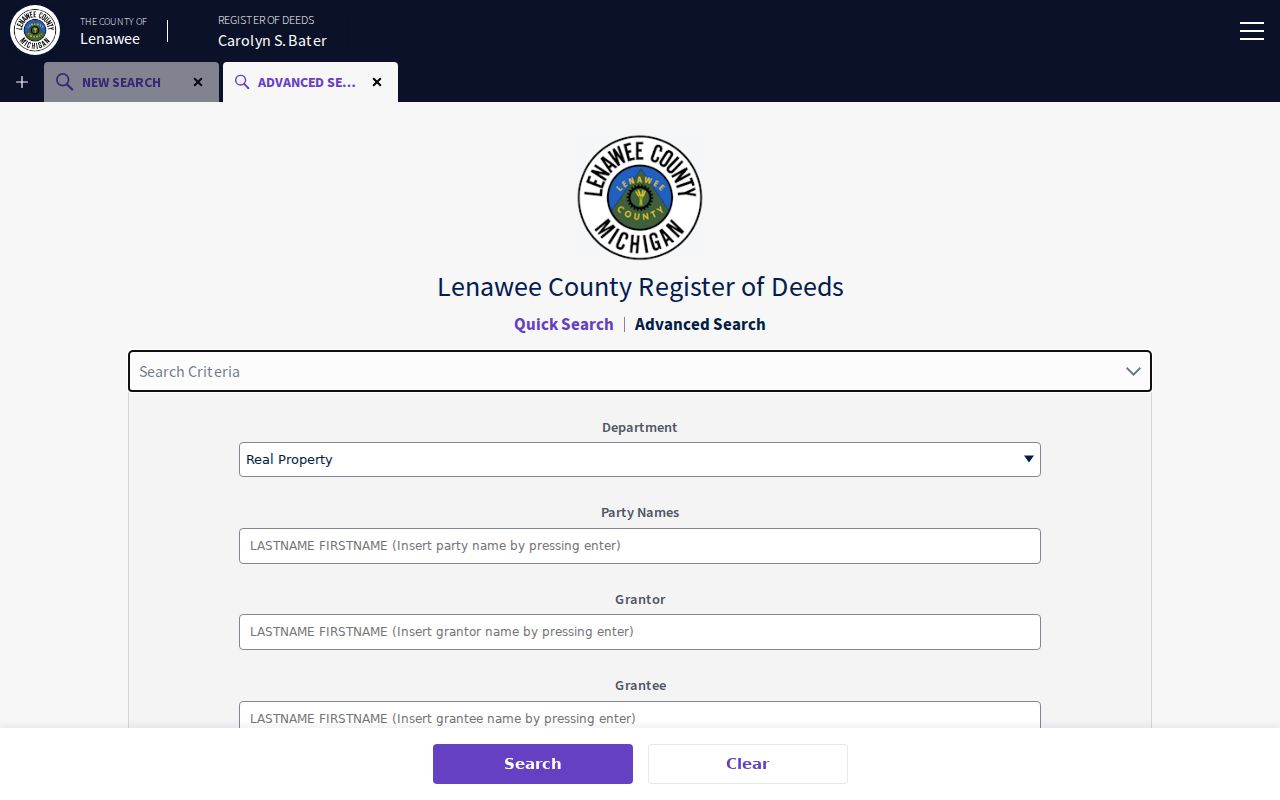
The search screen supplies a recorded-transfer lead. The instrument image and matching legal description are what connect it reliably to the Adrian address.
Adrian Address Records Beyond the Portal
The exact online cutoff for Lenawee deeds was not stated in the official pages inspected. Do not replace that missing date with an estimate. The recorded search supports party, recorded-date, document, legal-description, and OCR work, but an empty online result may mean that an older book, vault record, reel, or image has not been reached. OCR can help locate a phrase in legal text, yet the scanned document remains the record to read.
The Register of Deeds is at 301 N Main in Adrian. Its regular hours are Monday through Friday, 8:00 AM to 4:30 PM, with research-vault access until 4:15 PM. The office states $1 per page for office copies; the online viewing and printing route uses a $100 escrow account. Call the Register of Deeds before a visit to confirm the year, book, copy type, and access method needed for the address.
Note: A missing portal result should lead to the vault, deed books, microfilm, library, or archive before the address trail is marked incomplete.
Adrian Address Records in House Cards
The Lenawee County Historical Museum adds a building-centered layer to Adrian address-history research. The local house guide identifies street and address cards, SC survey cards, PP picture cards, House Abstracts in Range #1, maps, city and county directories, biographies, and tax journals. Start with the precise address and a date range. Ask whether a card uses an earlier number, archive code, or legal reference. A house card is a lead to inspect, not proof that every named person occupied the property.
The guide identifies the archive at 110 E Church Street and lists Friday and Saturday hours from 10:00 to 2:00, plus appointments. Confirm those details before travel. Its 2024 City Tax Records photography project is a useful local preservation story: every page was photographed and volunteers can search the photographs. Ask the museum for the current index, access conditions, and permissions, then cite the original journal page separately from the preservation copy.
Adrian’s records history combines bound books, archive cards, directory volumes, microfilm, and online indexes. No one layer covers the entire address trail. The museum is especially useful where the deed sequence needs a historic address form or a date to investigate.
Adrian Previous Residents in Households
Ownership is only one part of who lived at an Adrian address. A criss-cross directory, where available, starts with the street and number and can identify a historic head of household, phone, or printed occupancy code. A city directory can be annual while a census is decennial. Use the address, nearby household sequence, spouse or initials, and the exact year to decide whether two entries describe the same household. The individual collections and their observed years are covered on the Adrian city directory page.
The Adrian District Library Heritage Room holds federal census microfilm from 1830 through 1930, Michigan state census microfilm for 1845, 1884, and 1894, local indexes, newspapers, and directories. Its digital microfilm equipment can save images to USB or print. A focused email request should give one person, event, or location with accurate names and dates. The library does not promise an extensive family-tree or adoption search.
Use a simple household flow: directory year and street number, then newspaper search for the same name or address, then the nearest census, then a vital, probate, or deed record if the time and geography agree. An absence from one source can result from timing, travel, age, a spelling variant, or an unlisted household. A listing has to be read with its date and source type.
Adrian Address Probate Records
A final transfer in an Adrian deed chain may introduce an administrator, heir, trust, or quitclaim deed. That is the point to check Lenawee Probate Court rather than assume that a household simply vanished. The county’s genealogy materials begin in 1827 and use a surname plus an approximate death year for in-person research. Probate records can point to an estate, will, guardian, administrator, heir, or property transfer. Some files and personal details remain restricted.
The Lenawee genealogy microfilm page is the official county route illustrated below for older probate research.
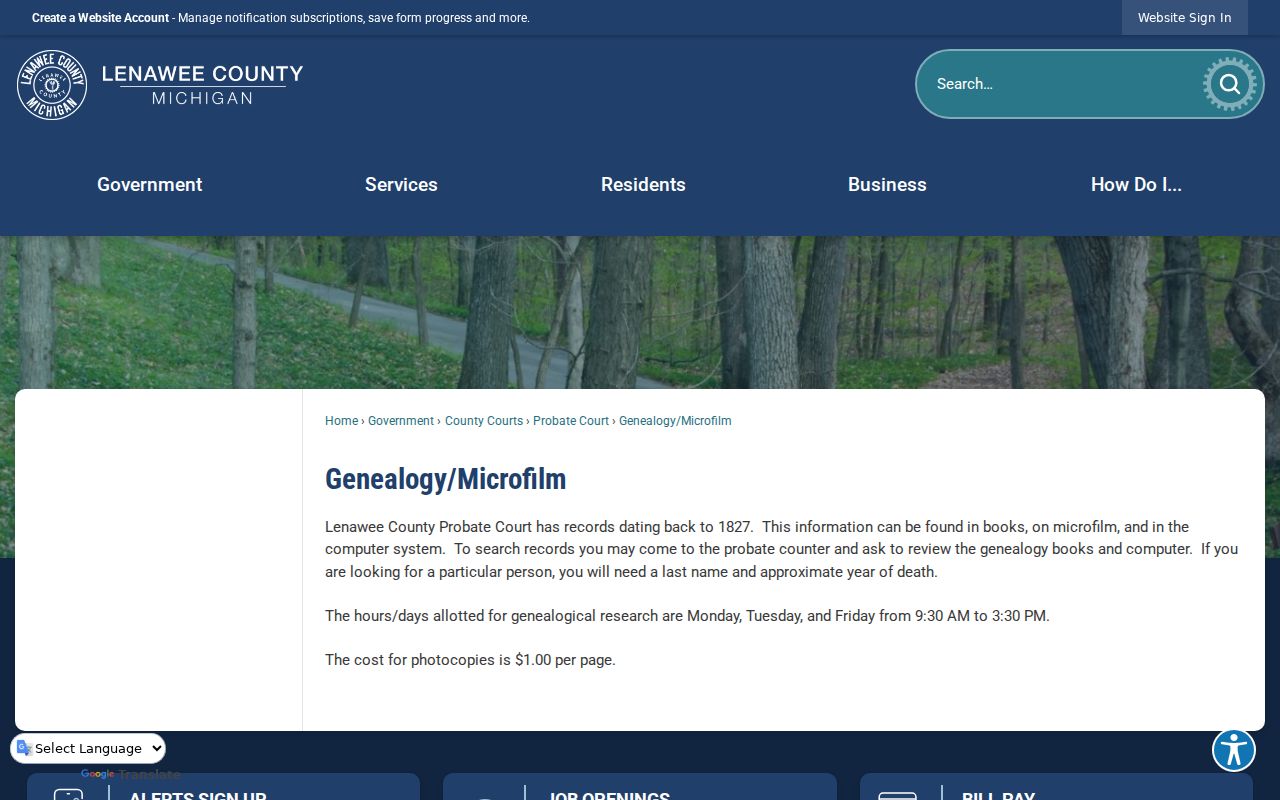
A probate lead can explain a transfer or family relationship, but it should be checked against the file and recorded instrument before becoming part of an Adrian house history.
Obituaries can add a dated public event and names of relatives, while a death record and probate file give different kinds of confirmation. The Adrian library describes the Daily Telegram Collection as 1893 to the present and older newspaper descriptions reaching back to 1849. Save the article title, page or image, event date, and relationship wording rather than copying sensitive details into an address timeline.
Privacy Limits for Adrian Previous Residents
Past residence research has clear limits. A deed does not name every household member. A historical address book can use a head-of-household convention. Birth records under 100 years and adoption records have access rules, and protected voter fields, juvenile matters, some court files, mental-health records, and victim information require special handling. Michigan’s Address Confidentiality Program offers a substitute address and mail forwarding for eligible survivors. A public source must never be used to defeat a protected address.
Michigan FOIA, MCL 15.231 et seq., is a route for sufficiently described existing records, not a request to build a personal history. Public bodies generally respond within five business days and may issue a written ten-business-day extension. Fees can cover searching, reviewing, separating, copying, and mailing. Courts and court clerks acting in their court-clerk role use different access rules, so seek the applicable court process for court material.
Lawful use. Adrian house-history and family-history research should remain personal and respectful. Never use a past address or record trail to stalk, harass, intimidate, or pursue a living person.
Adrian Address Record Confidence
Build an Adrian address timeline with a confidence label beside every item. A deed, map, or newspaper page read directly is primary image evidence. A county index is an official index until the instrument image is inspected. A library catalog or archive guide is an official finding aid. A local link or family note is a secondary lead that needs follow-up. This distinction lets a timeline preserve uncertainty without losing a useful route to the next record.
For each Adrian entry, retain the source URL or call number, source type, date, address form, jurisdiction, role shown, page or document reference, access date, and privacy review. Pair one official or primary source with an independent collection when possible. A good result may establish ownership, a historic household, an event, or a relationship. It should say exactly which one rather than turning an address trail into a claim about every person connected to the property.