
Adrian City Directory Collections
Adrian’s observed volumes survive as a set of pointers, not as one verified annual series. The local trail begins with an 1859 Adrian volume, followed by 1870 and 1876 pointers, then the 1897 Lenawee County Directory. The county book is useful, but its scope reaches into townships, so an Adrian conclusion still needs a street or municipal reference. Later Adrian volumes cluster before the First World War, in the late 1920s, and across parts of the mid-twentieth century. Treat a missing year as a collection gap until a catalog or title page proves otherwise.
| Collection | Years | Where Held | Access |
|---|---|---|---|
| Early Adrian volumes | 1859; 1870; 1876 | Adrian Architecture links and local-history leads | Inspect the linked holding, catalog, or volume |
| Lenawee County Directory | 1897 | Adrian Architecture and local county or library collections | Countywide source, verify city context |
| Adrian directory volumes | 1903, 1905, 1907, 1909, 1911, 1913, 1915-1917, 1921 | Adrian District Library Heritage Room and museum leads | Local collection research |
| Later Adrian directory volumes | 1925-1929; 1932-1953; 1955-1960 | Heritage Room and local archive leads | Verify the individual volume, reel, and scope |
The coverage table identifies volume years actually surfaced by the research. Publisher names and continuous annual coverage were not confirmed for every run, which makes the title page, page number, and geographic scope part of every usable citation.
Adrian City Directory Year Runs
The early years are best read as checkpoints. Adrian has observed pointers for 1859, 1870, and 1876, then a countywide 1897 directory. The local Adrian sequence resumes in 1903, 1905, 1907, 1909, 1911, and 1913, with 1915 through 1917 especially useful for comparing changing street numbers. A 1921 volume and the 1925 through 1929 cluster provide postwar comparisons. The later list includes selected years from 1932 through 1960, not a claim of uninterrupted publication.
- Start with the closest observed Adrian volume before the event or move.
- Check the closest observed volume after it, keeping each printed address exactly as shown.
- Use the 1897 county book or rural directory only after noting whether the entry belongs to Adrian or a township.
- Record the title, year, publisher if printed, page, and section before comparing another source.
That modest timeline prevents a common error: turning a list of known local volumes into a false annual record. The Library of Michigan’s catalog and the Heritage Room remain the appropriate places to test gaps, alternate titles, microfilm, and rare-book access.
Adrian Heritage Room Directories
The Adrian District Library’s genealogy and local-history collection is the practical first stop for Adrian directory research. Its Heritage Room brings together local-history material, governmental proceedings, local indexes, vital-record indexes, federal census microfilm from 1830 through 1930, Michigan state census microfilm for 1845, 1884, and 1894, and local newspapers. The library lists Monday through Thursday hours of 9:30 AM to 8:00 PM, Friday 9:30 AM to 5:30 PM, and Saturday 9:30 AM to 3:00 PM. Holiday hours should be checked before a visit.
The Heritage Room collection page is shown in the collection image below.
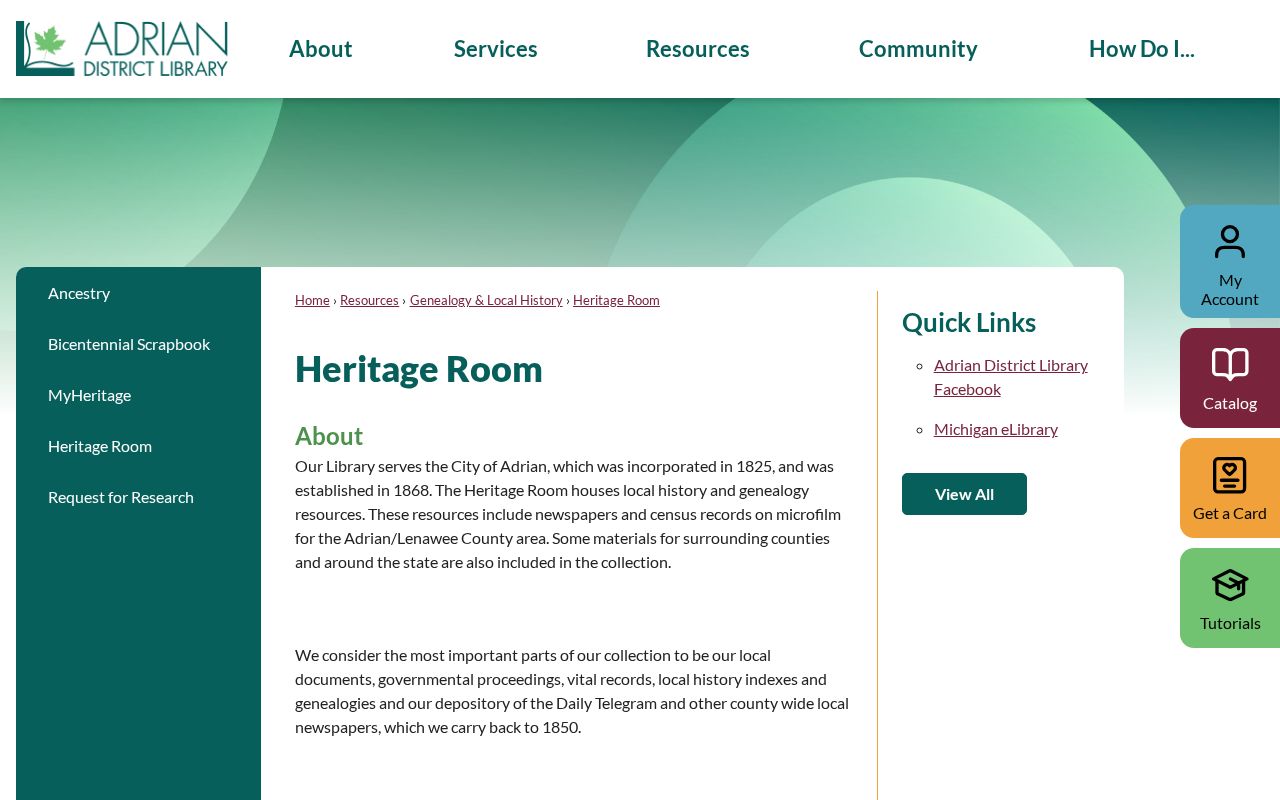
Its digital microfilm machines can save images to USB or CD and print, which makes it possible to preserve the directory page, newspaper citation, and census comparison together. For an email request, the library asks for a specific person, event, or location with accurate names and precise dates rather than an open-ended family tree request.
Adrian District Library
143 E Maumee St
Adrian, MI 49221
517-265-2265
Library of Michigan
Directory print and microfilm collections, catalog access, and rare-material guidance for Michigan research.
Adrian Newspaper Directory Trail
Directories gain strength when an Adrian newspaper supplies an event date or household detail. The library describes the Daily Telegram Collection as 1893 to the present, while its Adrian newspaper archive points to papers reaching back to 1849. Search a surname with the street, try initials and maiden names, and test spelling variants because OCR can misread older type. A notice or advertisement documents a public appearance, relationship, or event. It should not be relabeled as proof of permanent residence without another source.
The library’s local-history page also describes its newspaper and genealogy access.
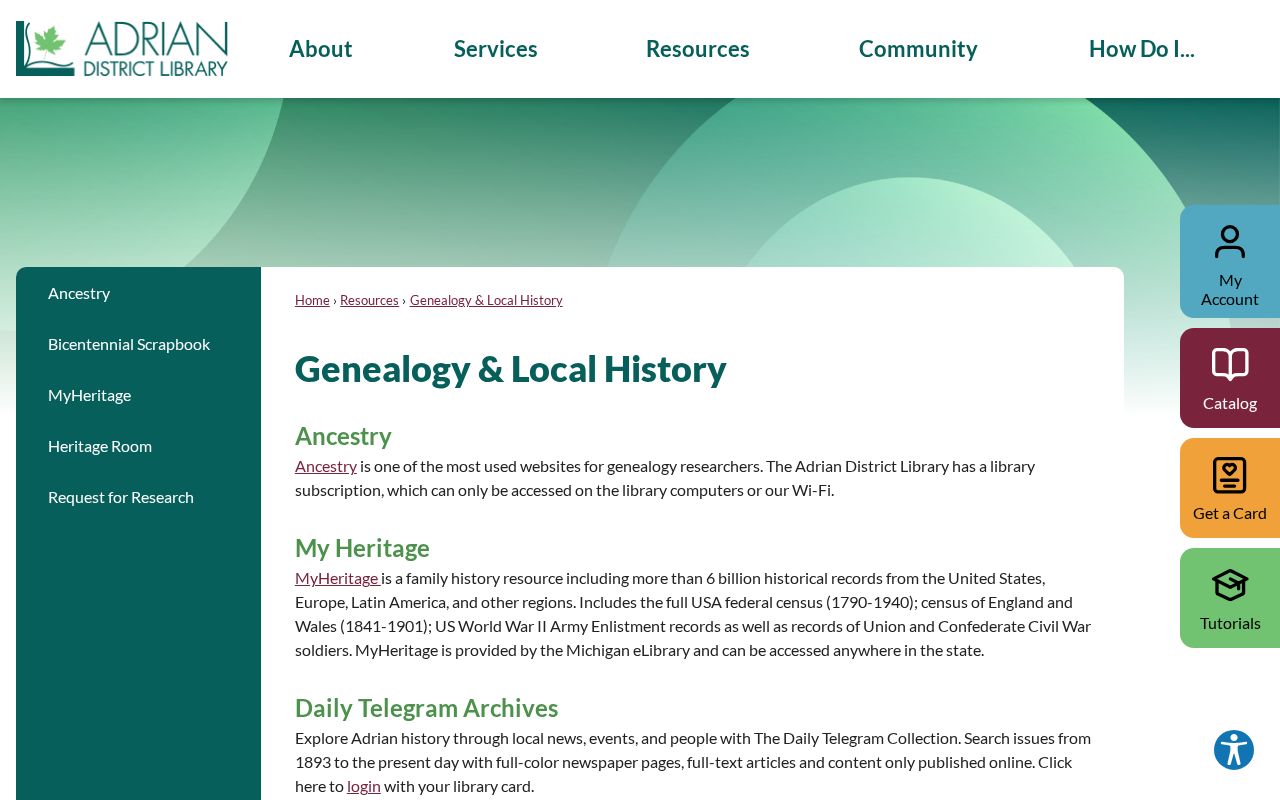
This long newspaper trail is an Adrian records story in its own right. A directory year can narrow a newspaper search to a name, address, and date range, while the newspaper can explain a move, death notice, business connection, or probate notice that the directory merely hints at.
Reading an Adrian City Directory
Each printed Adrian volume is a dated listing, not a modern profile. Polk-style books may group surname listings, street sections, phone listings, and classified material. The Library of Michigan notes that surname sections can include a professional or business descriptor, household members, and an ownership notation, while street sections can place residents or businesses at a house number. Individual Adrian volumes may differ. Photograph or transcribe the abbreviation key before interpreting a short mark.
| Printed name | Copy initials, spelling, and any head-of-household or household notation exactly. |
|---|---|
| Street address | Retain the house number, street form, apartment or room detail, and city or county scope. |
| Business descriptor | Use it as a dated public connection, not proof of a complete life history. |
| Ownership notation | Read the volume’s key first; a printed symbol does not establish day-by-day occupancy. |
| Page evidence | Keep the title, year, page, reel or scan identifier, and section with the entry. |
- Criss-cross directory
- A reverse section arranged by street and house number, useful for finding the listed household at an address.
- Householder index
- A name-based portion that identifies the person or household under the volume’s own editorial rules.
- Abbreviation key
- The volume’s explanation of its marks and shortened words; capture it before expanding any symbol.
Adrian Directory Number Changes
The August 1916 Sanborn book contains old and new Adrian street numbers. That small local detail can prevent a false conclusion that a household disappeared or moved. Compare a 1915, 1916, or 1917 directory entry with the Sanborn address conversion, then test the property description or street card if the names do not line up. An unchanged family name paired with a changed number deserves investigation before a timeline is rewritten.
Adrian Architecture’s historical links gather local directory and map pointers, including the Sanborn material.
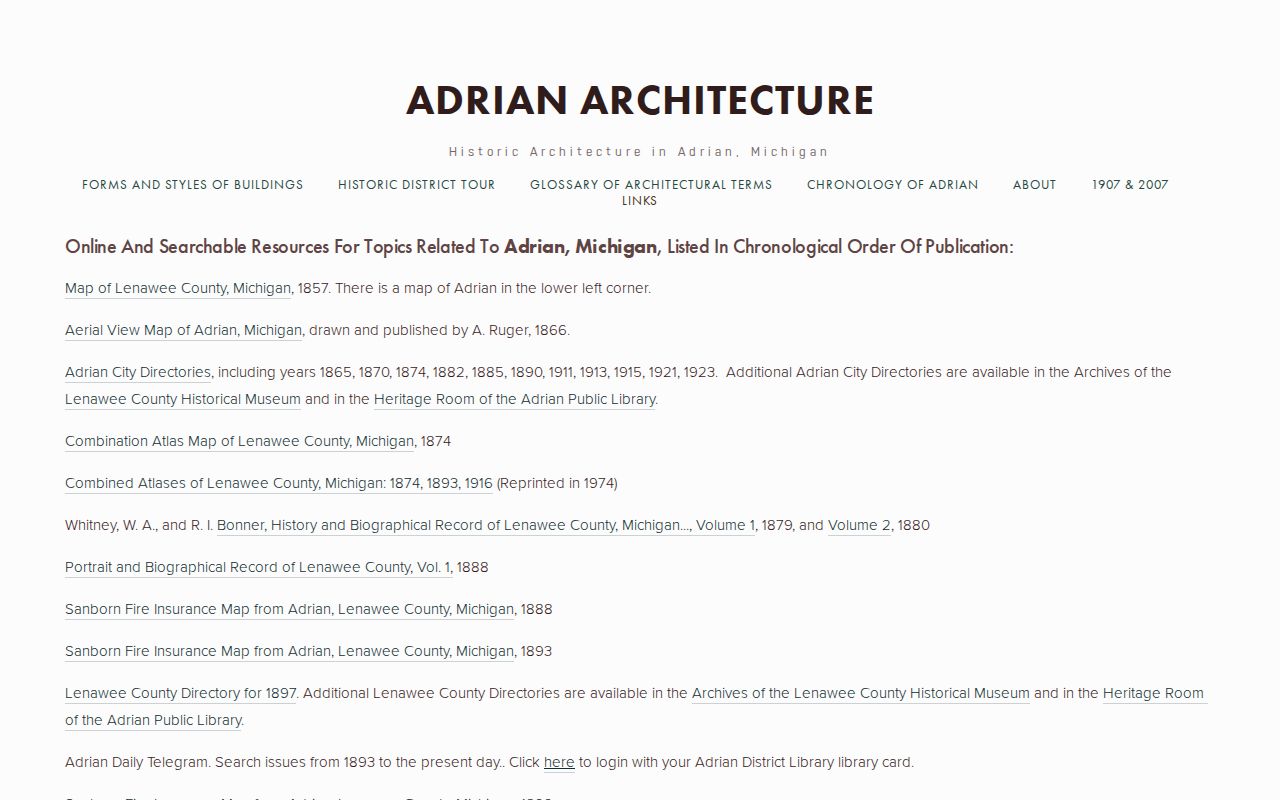
The image points back to the local collection network rather than claiming a digitized run is complete. Adrian’s old and new numbering bridge is most useful when the directory, map, newspaper, and deed or archive card each place the same household in a compatible time period.
Note: Preserve both printed numbers and label the source year, because the 1916 conversion can change the address trail without changing the household.
Tracing Adrian City Directory Families
Build a family timeline from the narrowest reliable fact: a name, approximate year, street, spouse, parent, business, or event. Locate the person in the nearest Adrian directory, then record the address and listing form without silently merging similar names. Pair annual or intermittent directory evidence with the decennial federal census and, where useful, the 1845, 1884, or 1894 Michigan state census microfilm held locally. The different schedules do not have identical timing, and a missing listing can reflect travel, a name variant, age, or editorial practice.
- Find the earliest observed Adrian volume near the known date and save the full citation.
- Follow the surname through later observed volumes, noting spelling, household role, street, and any number conversion.
- Search the street-order section when the volume offers one, then compare nearby names only as leads.
- Use a newspaper issue for a dated event and census microfilm for household structure.
- Confirm a legal event through the appropriate clerk, probate, deed, or state record route when needed.
A historic directory result that needs a current or official confirmation belongs in the Adrian resident lookup workflow. The two tasks differ: a directory establishes a printed local listing for its year, while current public records have their own source rules and protections.
Adrian Directory State Shelf
The Library of Michigan’s city-directory guidance directs researchers to print and microfilm directories through the ANSWER catalog and second-floor collections; rare materials require the Rare Book Room. Its explanation of Polk and Bresser formats helps interpret an Adrian volume without assuming every local book used the same arrangement. Library computers or Wi-Fi at Adrian District Library also provide Ancestry Library Edition, while MyHeritage is available through Michigan eLibrary for eligible users.
The statewide directory guide is captured in this collection image.
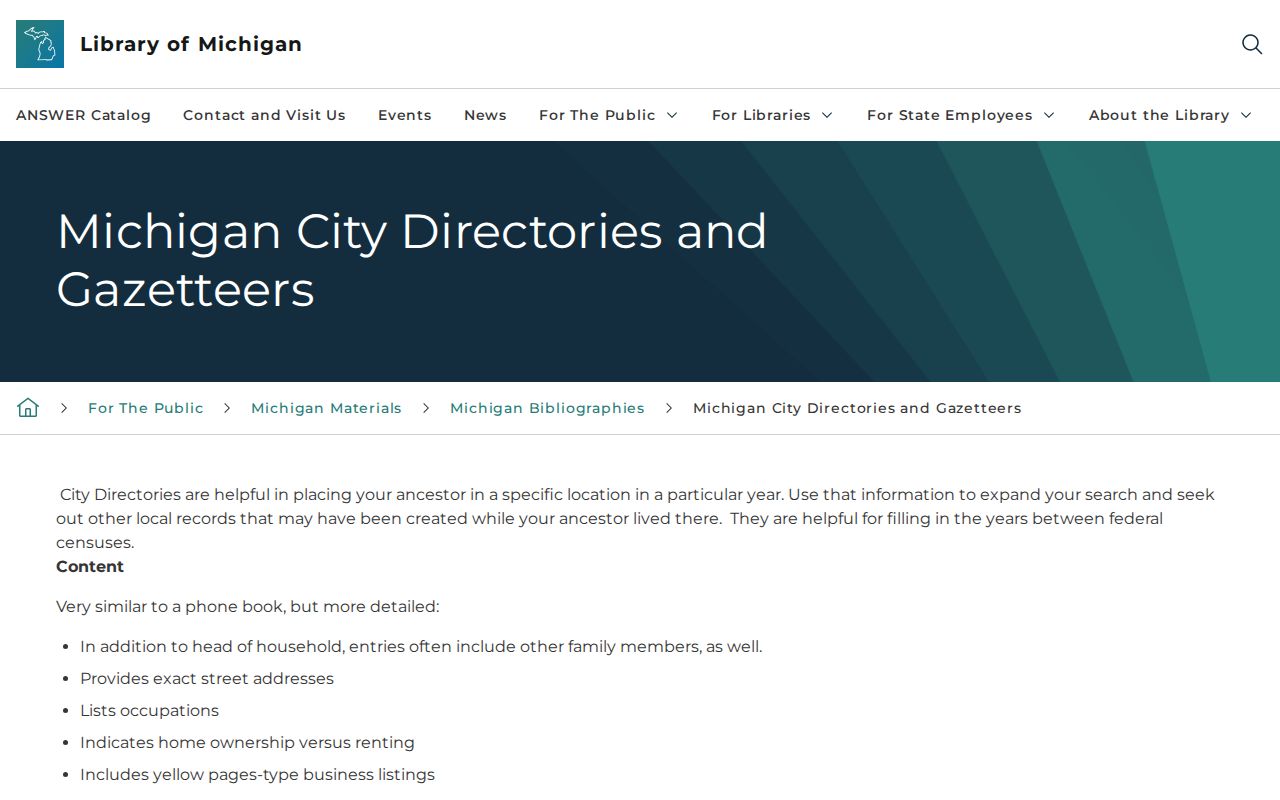
Catalog guidance establishes where and how to seek a volume, not that a specific person appears in it. Check the title page, city or county scope, page image, and publication year before treating a catalog hit as evidence.
Adrian Probate Directory Leads
Lenawee probate genealogy material reaches back to 1827. For an Adrian family question, a surname and approximate death year can lead to an estate, administrator, heir, will, guardian, or property-transfer reference. The county’s genealogy route is in person, uses surname plus approximate death year, and states $1 per page for photocopies. Sensitive and restricted material remains outside a routine directory search.
A probate lead can explain why an Adrian listing ends or why a recorded transfer changes names. It does not prove that every heir lived at the directory address. Pair it with a directory page, newspaper notice, deed image, or vital record that matches the same time and relationship.
Adrian Directory Evidence Rules
Use source roles precisely. A printed volume can show a listed person or household at an address in a particular year. A deed names a grantor or grantee in a recorded transaction. A tax record can name an owner or taxpayer. A newspaper can report an event. Those roles overlap sometimes, but they should not be combined without evidence. Adrian’s city-and-county overlap also matters: a mailing address or county directory entry can reach beyond City of Adrian limits.
Keep a short research log with searches that failed, variant spellings, date ranges, and collection boundaries. When an online index stops, move to the Heritage Room, museum archive, Library of Michigan, or the county custodian instead of treating the gap as proof that no record exists. Note: A well-cited Adrian directory finding states what the printed entry shows and what it cannot establish on its own.